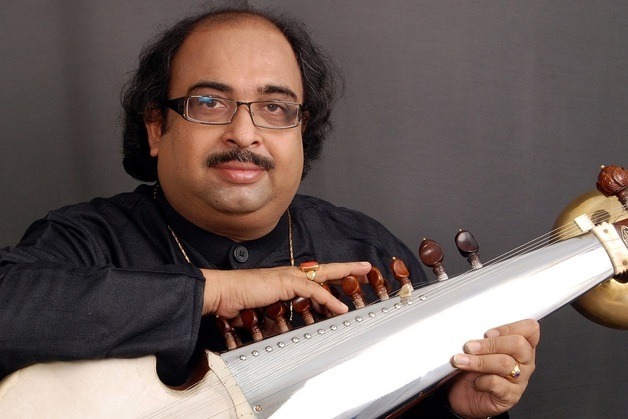
A tête-à-tête With Pandit Tejendra Narayan Majumdar

Pandit Tejendra Majumder is one of the most authoritative and undying inspiration in Indian classical music to the modern eon. Tejendra Narayan has successfully united the techniques of Tantrakari and Gayaki style.
Strings N Steps
Inside Words with Sangeeta Majumder for Strings N Steps Magazine
Curated by Priyadarshi Banerjee
Photography by Sunando Das
Indian classical music and dance are that fragrance from an incense stick that engrosses us slowly keeping alive the aroma for a long long time. It is also obvious that definitions would vary
from people to people much due to – how they perceive this art form – as a vocation or avocation. India is travelling through massive alterations in the field of classical music-dance and it might lead to evolution or beldam. Innovation has diminished the compartmentalisation of various music-dance forms which might not be suitable if we consider the speciality of their origin. Still let us consider that currently there is a boom of Indian classical music in the country. In the ongoing trends there are few who have been clear in their devotion towards the real virtues of Indian classical music. It’s though provoking to envisage a vivid artist but it’s always a pleasure to hear the story- through which they have shown exemplary talent, grace and artistic panache.
Q. Can you put into words your own Personality and Persona?
I am a simple person. I always try to reach the sky keeping my feet on the ground. My Gurus always taught me, “First be a good human being, then you can become a good musician”. I still try to follow it.
Q. You are one of the leading Indian classical musicians now. Did you program things this way?
Not really. I was born in a musical family. My father was a professional Sitar player, and my uncles were also into music. I loved music since I was a kid. And somehow it turned out to be what you can see today of me.
Q. There are many changes occurring in India. Yes, indeed. Parampara, in Sanskrit, means tradition, which undergoes uninterrupted change. In this context, what do you think, where does Indian Classical music stand?
The basic discipline of our music has remained more or less the same, though, perhaps, it has evolved for good, at least to keep pace with the time. Indian Classical Music is actually a growing form of music. More and more people are loving it nowadays. So I genuinely feel extremely happy and positive of its viability in the modern world.
Q. How would you describe your music? According to you which part of your rendition makes you different from others. Does your style bear any innovation?
I try to maintain a balance between the aesthetic beauty of our music and the technical skill required to create such beauty coupled with the Taalim which I am fortunate enough to receive from my great Gurus – Swara Samrat Ali Akbar Khan and Ustad Bahadur Khan. I try to make my Sarode resemble vocal music featuring Dhrupad and Gayaki Styles alternated with the rich Tantrakari styles of Maihar Gharana Sarode playing.
Q. Will you throw light on your Guru’s method of teaching? Is it different from yours? If yes-How? If no-why?
My Gurus never allowed me to record or note any of their lessons. So I had to grasp all I could at that very instant while they were teaching. But now, my students are allowed to record or note my lessons. But still I try to instill the power of grasping at the first instance among them, specially to those who are in the advanced stage of learning.
Q. Do you think that there are separate methods or techniques in dance for man and woman?
I have no idea of it, as I am not a dancer.
Q. Does your heart still miss a beat before concerts after so many years of experience?
Of course. The stage remains to be a stage, no matter how many years I have spent on it. Every stage seems new to me. Every dais tests my ability. Every concert is a challenge for me. I try to enjoy my music every time I sit for any concert.
Q. How do you rate your success?
I don’t know how to rate it. I just want to become a better musician tomorrow.
Q. There is a popular opinion that the Younger generation isn’t much interested in classical music- dance forms. Do you agree? How would you justify your opinion?
To be brutally honest, I really feel that the interest is actually growing for Indian Classical Music and Dance among the younger generation. I see so many amazing young talents learning and performing Indian Classical Music across the nation. I don’t remember if I saw these many youngsters in our music and dance during our times. It is true, the media focuses on the other forms of music and dance, so these amazing young talents miss the glare of the media. But that doesn’t necessitate that the younger generations are losing interest from it.
Q. Can you share your most memorable onstage moment?
There is no such single moment. Every time I strike the first note on my Sarode to start my recital, it becomes memorable to me.
Q. What is your favourite Idea of Holidaying? Do you think it is necessary to have leisure-voids while working?
I love sea beaches. Holidaying is of course necessary to rejuvenate one’s creativity.
Q. If you were given the chance to live again, how would you want it to be?
I want to be a musician once again. As it is impossible to learn even a drop of music in one’s whole lifetime.